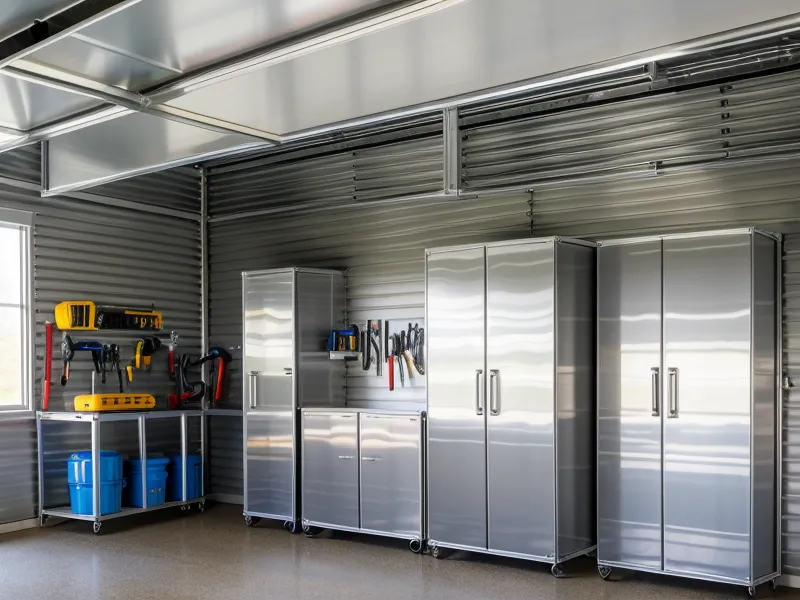
Eighty gallons of stored water weighs more than a loaded refrigerator, all of it pressed into a footprint smaller than a bar stool.
Update (September 2026): Aqua Tower is no longer available for purchase; this article is kept for reference. Our current alternative pick in this category is Water Freedom System.
The common assumption with a stackable system like the Aqua Tower is that going vertical is just an upgrade over horizontal barrels — same rules, just taller. That assumption is the actual myth: floor load, not capacity, decides whether an emergency water storage setup like this works or ends up cracking your garage slab.
Quick disclosure before the troubleshooting starts: this site runs on affiliate links, including ones for the Aqua Tower and the SmartWaterBox drainage setup mentioned further down — I earn a commission if you buy through either, at no extra cost to you. None of that changes the math below; I am not a structural engineer, just someone who treats garage organization and water storage like an ongoing troubleshooting ticket, so treat any floor-load numbers here as a reason to call a professional, not a replacement for one.
The Myth: More Gallons Always Means Better Prepared
Bulkhead fittings on a system like this are PVC, and the plastic itself held up fine — it was never the fittings that worried me. The real difference between this and a barrel is footprint: barrels spread their weight across a wide base, while a stackable tower concentrates the same volume into a narrow column, and I have gone through that Aqua Tower vs Blue Barrels comparison in more detail elsewhere — a barrel wants floor space, a tower wants floor strength.
Capacity planning is its own separate exercise from setup, too — how many gallons a household actually needs is a different calculation than whether a garage can physically hold the hardware picked to store it. The Sam's Club on I-10 West near me sells out of anything water-shaped within a day of a hurricane watch, and that shopping-panic pattern is exactly what pushes people toward a big fixed system instead of restocking jugs every storm season.
Can Your Garage Floor Actually Handle 667 Pounds?
Two 40-gallon stackable units add up to a full 80 gallons of capacity, and water is not light — at roughly 8.34 pounds per gallon, that works out to a total system weight of about 667.2 pounds sitting inside an 18-inch by 18-inch base, a footprint of 2.25 square feet. Divide one number by the other and you land at about 296.5 PSI pressed into that small a square, which is a number worth knowing before you fill anything, not after.
The decision criterion is simpler than the math looks: work out your own total weight and footprint the same way, compare it against what your slab or floor is actually rated to hold, and if you cannot get a straight answer on that rating, do not stack the full system in one spot. Apartment and townhouse floors are where this trips people up most often — a slab poured for a family room was not necessarily poured for a concentrated load like this, and a high-rise unit almost certainly was not. That is not an argument against vertical storage; it is an argument for asking the structural question before the plumbing one.
Leveling and Gaskets: The Part the Manual Undersells
Leveling the pad under the tower took longer than the actual assembly, mostly because the slope was invisible until a level was actually on it — the same way a server rack looks fine until you notice the doors do not swing right anymore. Skipping that step is how a stackable system turns into a leaning one, slowly, over weeks instead of all at once.
Gaskets and bulkhead fittings are the other spot people rush. A gasket seated even slightly off will hold air pressure just fine and still weep under standing water, which is a distinction most people do not learn until the floor is wet. Craig Delacroix, a guy I know through a Houston-area prep group online, dropped off a spare gasket kit he had sitting in his own garage so I could compare a fresh seal against the factory one side by side. Lending out spare gear for exactly this kind of real-world test is basically his whole personality at this point.
Troubleshooting a Drip Without Flooding the Garage
A slow drip from a bottom spigot is a different emergency than a burst line, and it deserves its own plan precisely because it will not announce itself the way a real leak does. That is where the SmartWaterBox earns its keep — it routes a slow failure into something manageable instead of turning into a five-gallon-bucket relay race across the garage floor.
The SmartWaterBox is basically cable management for water, and I go into more depth on it in my SmartWaterBox Review — but watching it handle an actual drip is what convinced me it was not just a gadget collecting dust on a shelf. None of this replaces basic sanitation, either: a container-sanitation routine is a separate checklist from leak management, and treating the two as the same task is how people end up with a dry floor and contaminated water anyway. The one thing I can tell you flatly does not work: bleaching a footer-a116d1 after watching a YouTube tutorial, which left the water tasting like a swimming pool for a week afterward — whatever the actual ratio was supposed to be, that was not it, and rinse cycles get taken a lot more seriously around here now.
A Different Kind of Water Test
Test strips confirm the chemistry is fine, but they do not tell you whether anyone in the house will actually drink the water without complaint. The more convincing test lately had nothing to do with strips at all: a bowl of water treated with Dark Reset went down for the dog one afternoon, and she drank it straight through without even pausing to sniff first, which is more than she does for some of what comes out of the tap.
My neighbor Preethi, a couple of blocks over, ended up running her own version of that test after she saw the tower going in — she borrowed two filter setups from the garage and did a side-by-side comparison on her own schedule, which is really a filtration question layered on top of a storage one. Purification and filtration solve two different problems, and confusing them is its own common mistake: storage buys you time, while filtration or purification is what actually makes the water safe to drink once you need it.
The Real Verdict on the Aqua Tower
The corrected version of the myth is straightforward: a stackable tower is not simply a bigger, taller barrel, it is a trade of floor space for floor load, and that trade only makes sense once you have actually checked what your slab can take. Tap an empty barrel sometime and you get a hollow, almost tinny knock — that is the sound of unused capacity, and it is a completely different sound once hydrostatic pressure is holding 80 gallons steady instead.
Start with the floor question before the plumbing question, and do not assume a taller system is automatically the smarter choice just because it holds more water in less space. Skip that order and you are just guessing with several hundred pounds of water balanced over a slab you never actually tested.
Where This Fits With the Rest of Your Water Plan
None of this matters much if the baseline number underneath it is still a guess. Settling on a household's gallon-per-person-per-day target should come before deciding whether 80 gallons is overkill or exactly right, not after — that math is broken down in 72 Hours of Water for $100 for anyone who wants to start smaller and scale up later.
A tower this size is not portable, and it was never meant to be. It solves a shelter-in-place problem, not a bug-out one, and those are two different emergencies calling for two different kinds of gear. Chemical treatment drops carry their own shelf life to track, separate from how long stored water itself stays good sitting in a tank. A gravity filter's flow rate matters more than its price tag once drinking water is actually being pulled out of a tank this size during a real outage. Two 40-gallon tanks are also not something to rotate out on a whim, and an actual rotation schedule matters more at this scale than it ever did with a few jugs under a shelf.