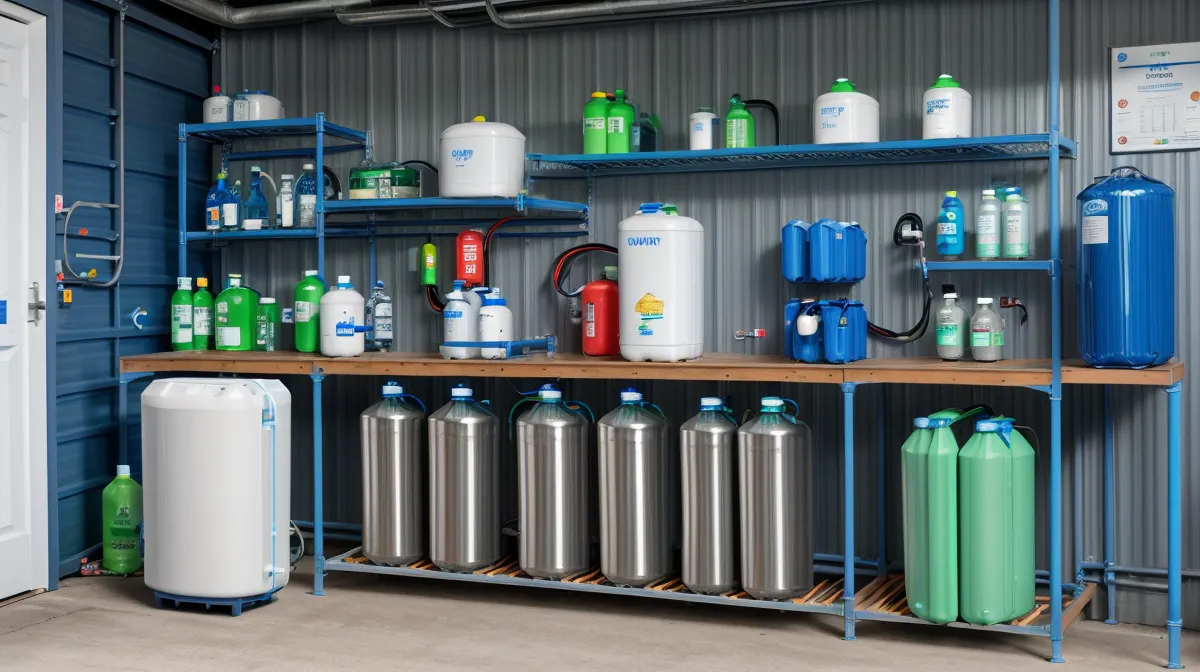
A full 55-gallon drum weighs more than four hundred and fifty pounds. That single number is the reason three of them are no longer blocking the path to my lawnmower.
Update (September 2026): Aqua Tower is no longer available for purchase; this article is kept for reference. Our current alternative pick in this category is Water Freedom System.
Quick housekeeping before the technical part: this page includes affiliate links, and if you buy through one I earn a commission at no cost to you. I don't get a review unit and a script to read from — I buy the gear, run it in my own garage, and write about what actually happens. If a product doesn't hold up, that's what you'll read here, not silence.
The obsession started with Hurricane Beryl, when our taps went dry for four days back in 2024, and it hasn't really stopped since. Here's where testing emergency gear in that garage has landed me, documented in The Garage Water Storage Experiment: one big passive reserve is not a plan, it's a single point of failure with a lid on it. A real suburban water storage setup needs layers — a sized bulk supply, a rotation habit, an active backup, and something portable — the same way I'd never trust a network to one router with no failover.
The Blue Wall Problem, Diagnosed Like a Ticket
Picture the blue barrels as a support ticket that never gets closed. Water sitting in plastic absorbs whatever's in the air around it — including the gasoline and pesticide fumes that hang around most garages — and at 8.34 pounds per gallon, a full 55-gallon drum tops 450 pounds before you've done anything with it. I once tried muscling one of mine a few feet to make room for a shelving unit and gave up halfway, out of breath, with a strained lower back to show for it. A 275-gallon IBC tote is worse: that's a structural commitment, not a supply.
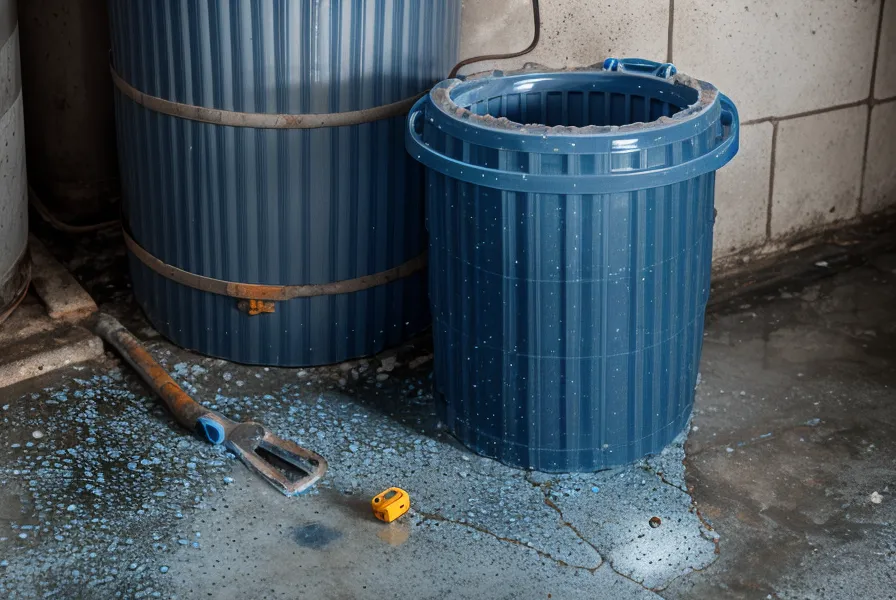
My second attempt wasn't much better. I switched to stackable plastic jugs, the kind marketed for exactly this, and by the end of one Texas summer in the garage the seams had cracked and split — heat does things to plastic that the packaging never mentions. The garage looks different today: the drain in the concrete floor near the back wall actually gets used, a pegboard holds hose fittings and hand pumps within reach, and a row of labeled containers along one wall stacks up to about shoulder height. There's a sink with a cold-water tap off to the side, used strictly for fill-and-flush testing, nothing else.
Sizing the Bulk Reserve Without Guessing
Layer one is just a sized reserve, and sizing it is where most people either overbuild or underbuild. I ended up replacing the barrels with the SmartWaterBox as the core of that reserve, mainly because it reports its own status instead of making me guess. For households without a two-car garage to dedicate to this, something like the Aqua Tower solves a different problem — vertical, modular units that split the load across a few closets instead of one 450-pound structural commitment sitting in a single spot.
The math behind how much you actually need is its own rabbit hole, and I won't re-run all of it here — the FEMA daily water recommendation of 1 gallon per person is the floor, not the target, and scaling that number to a real household and a real garage footprint is a separate calculation entirely. What I will say: most standard water heaters already hold 40 to 50 gallons, which counts as a hidden layer-one reserve most people forget to inventory.
How Rotation and Sanitation Keep the Reserve Honest
A sized reserve that never gets checked is just a barrel with better branding. The CDC's general guidance is to rotate stored water roughly every six months if it isn't commercially bottled, and that habit is layer two — not exciting, but it's what separates a working reserve from a science experiment sitting in the corner. Sanitizing containers between fills, tracking shelf life on any chemical treatment drops in the kit, and rechecking a rotation calendar against the actual date all belong to that same layer, and I keep a note on my phone for it instead of trusting my own memory.
Tiffany Bui, a colleague of mine, is a big part of why I got more disciplined about all of this — she won't accept a claim from me unless it's backed by a number or an actual guideline, which is a fair standard I don't always meet on the first try. Heat is the variable people underrate most in a Houston garage: containers that look fine in a showroom photo can fail under a summer of temperature swings, which is exactly what happened to the stackable jugs I mentioned earlier.
Where Smart-Home Filtration Fits in the Stack
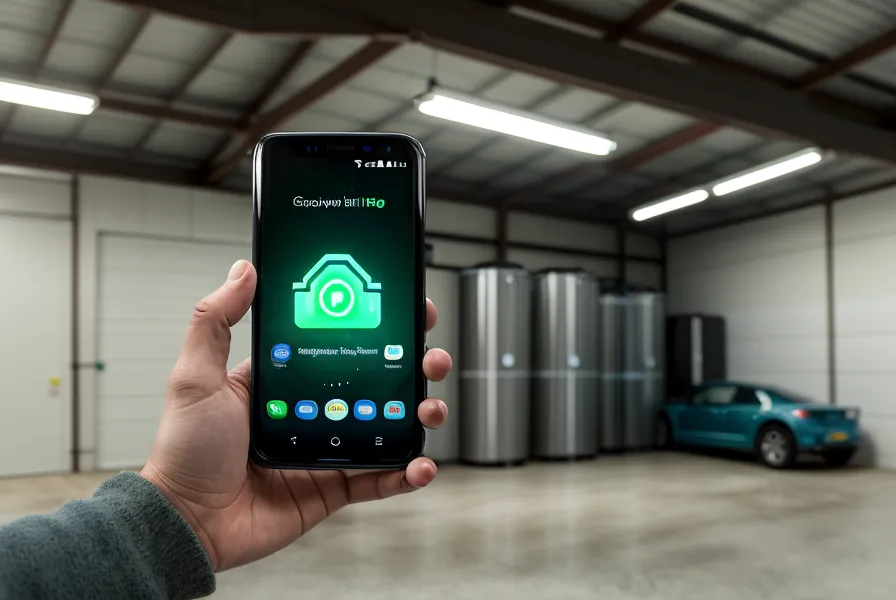
Layer three is the active backup, and this is where smart-home integration actually earns a place in the plan instead of feeling like a gadget for its own sake. Filtration and purification solve different problems, and treating them as interchangeable is one of the more common mistakes I see people make when they're building this out for the first time. A gravity filter's flow rate matters more than the marketing photos suggest — under real pressure, slow is a real limitation, not a minor inconvenience — and the range of contaminants a given filter actually clears varies a lot more between products than the packaging admits. When the SmartWaterBox automated cycle finally ran clean on its first full pass, the sensor turning green mattered less to me than knowing it would flag a failure on its own, without me remembering to check it.
None of that replaces checking your water after an actual event. I've got a separate writeup on how long you can store water before it becomes unsafe, and it's worth reading before you assume a stored gallon is still good just because the footer-a116d1 looks intact.
Portable Backup and the Flood-Specific Risk Layer
Layer four is portable — something that leaves the garage in a bag, not a plan that only works if you're standing next to four hundred pounds of stored water. Bulk and portable solve different emergencies, and mixing them up is how people end up stranded with plenty of water they can't move. A reader named Darnell Fontenot emails me fairly often, and because he's watched flood behavior firsthand near Addicks Reservoir on the west side of Houston, he evaluates gear differently than I do — he asks about contamination risk after standing floodwater before he asks about capacity, which reordered how I think about that layer entirely.
Our dog settled a smaller version of that question for me once, in a roundabout way. I'd set a bowl of water treated with Dark Reset down for her without thinking twice, and she drank it straight off without the usual sniff-and-hesitate routine — which told me more about how it actually tasted than any spec sheet did.
Every layer here is necessary, and no single one is sufficient on its own — that's the whole point of building a plan instead of buying a barrel. If I'm recommending a starting point, it's the SmartWaterBox as the core of layer one, mainly because it's the only piece of this stack that tells you when it's failing instead of waiting for you to find out during an actual outage. The rule I use now, for any product or habit I'm deciding whether to keep: if it can't survive a rotation check, a Texas summer, and a power outage without me babysitting it, it doesn't belong in the plan.