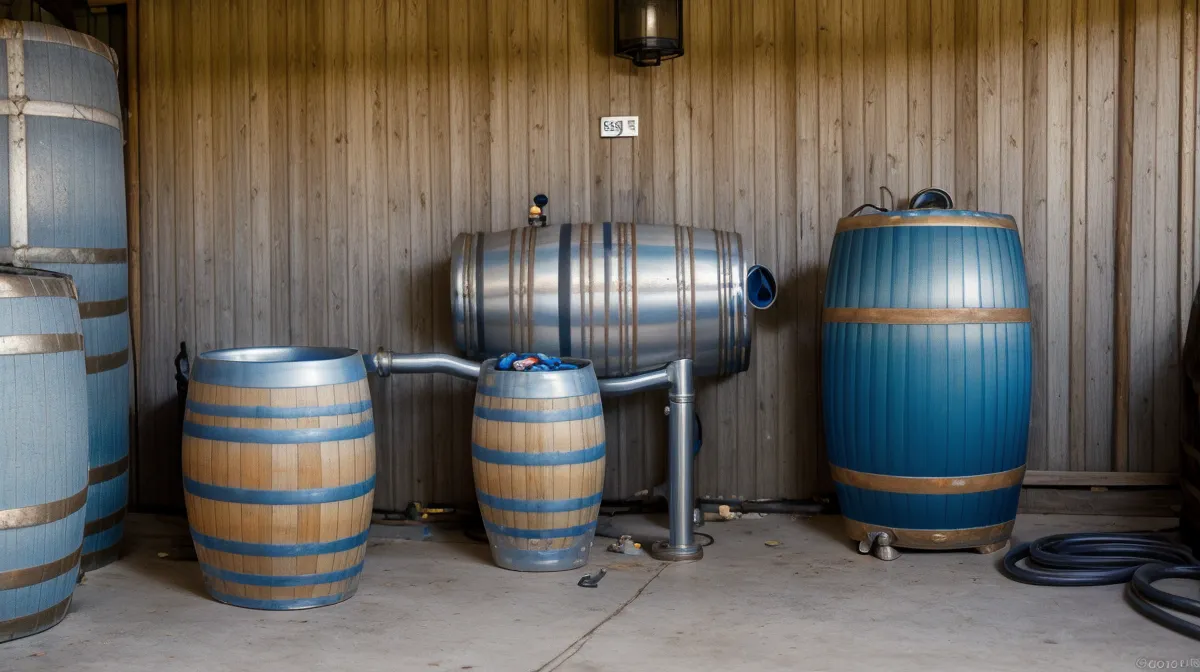
A full 55-gallon water drum tips the scale at somewhere past 450 pounds once you count the barrel and the pallet underneath it — dead weight parked in the corner of a garage, no wheels, nothing easy about moving it once it's full. That single number is really the whole argument for and against building your suburban preparedness around one giant footer-a116d1 instead of something smaller. Rotating mine taught me that water storage isn't a purchase you make once and forget; it's a maintenance routine, and the size of the barrel decides how much that routine costs you in time and sweat.
The 55-Gallon Barrel vs. the Costco Case Stack
Before the barrel, my plan for water during Hurricane Beryl was five cases of bottled water stacked against the garage wall — the kind of setup that feels responsible right up until day two of an outage, when it's already gone and the tap still isn't back. Beryl left a lot of Katy without water for days, and I remember driving past the spillway near Barker Reservoir with the water pushed higher than I'd ever seen it, thinking about how little five cases actually covers for a family that size. That gap is the entire reason a barrel ended up in my garage.
Cases scale differently than a barrel does. Bottled water is portable, grab-and-go, and easy to rotate a few bottles at a time — you drink the old ones on a normal week and replace them on the next grocery run, no siphon required. A 55-gallon drum is the opposite: you buy the capacity once, up front, and then manage it as one enormous unit instead of restocking gradually. My neighbor Sandra Kwan ran into that exact fork last year. She messaged me after seeing my notes on the neighborhood app, wanting to copy my spreadsheet, and when I walked her through what a family of four actually needs, she almost stuck with more cases instead — cases felt less intimidating to store and rotate than a barrel she'd never handled before. She went with the barrel in the end, but her hesitation was the right instinct: bigger isn't automatically better, even though it looks more serious sitting in a garage corner.

Running the Siphon Without Flooding the Garage
Draining a barrel that size isn't as simple as tipping it over. I ran a siphon and a garden hose out the side door toward the driveway, and the first twenty minutes were nothing but a sore forearm and a few sad dribbles before the flow finally caught. My neighbor Mel Okonkwo — who I met in the driveway during Beryl while we were both untangling generator hookups, and who's turned up for pretty much every garage test since — stood there keeping score, the way she does with anything that's ever failed us during a Houston storm. She wasn't wrong to watch that closely because a hose that slips while a barrel this size is draining turns into real water damage fast, not just a wasted afternoon.
Once the flow catches, you're tethered to that barrel until it's empty — there's no walking away from a hose actively draining forty-some gallons onto a driveway. That's really what separates barrel maintenance from everything else on a prep checklist: it demands a solid block of uninterrupted time, not five spare minutes between other chores. That single requirement is why I eventually wrote up the garage water rotation routine I follow now, mostly so I stop treating every rotation like a surprise.
The Barrel Itself: HDPE, Weight, and Sediment
These drums are built from high-density polyethylene (HDPE), and how well that plastic holds up against a Houston summer matters more for long-term durability than most people think about before buying one. Empty, mine was still heavy enough that I ended up wrestling it a few inches across the pallet just to clear the doorway, and a thin layer of sediment had settled on the bottom that needed a manual rinse before I'd trust the barrel with fresh water again. None of that is dangerous, exactly — it's just the kind of maintenance step a shelf of bottled cases never asks of you.
Nobody Warns You About the Maintenance Routine
Treating the refill is where people either get careful or get lazy, the same instinct that lets a full hard drive sit untouched until it's actually a problem. I'm not a water-treatment professional, so I follow a measured bleach treatment based on published guidance instead of guessing at ratios — and treating stored water is a different task from filtering water pulled from an unknown source, two problems that are easy to mix up if you're new to this. Sanitizing the footer-a116d1 itself is its own process, and it honestly deserves more room than one paragraph in a barrel story.

How often you actually rotate the barrel is its own question, one that depends on more than a gut feeling about freshness. I mark the date on the side of the drum in Sharpie every time I refill it, mostly so I'm not relying on memory to know when the next one comes due — the same reason I'd never trust myself to remember when I last rotated the smoke detector batteries.
When Smaller and Portable Makes More Sense
A barrel like this makes the most sense as a fixed, whole-house backup — it's not something you grab on your way out the door if a storm forces an evacuation. Bulk storage and portable storage solve two different emergencies: one covers you if you're sheltering in place for an extended outage, the other covers you if you need to move fast. Sandra's family ended up with the barrel plus a smaller portable setup for the car instead of picking just one, and that split mattered more in the end than the size of either container. Figuring out how many gallons per person per day your household actually needs is step one of that planning, and it's worth doing that math honestly before you buy anything.
I've been field testing four modern water backup solutions that trade the barrel's raw capacity for flexibility, and where you land depends on what kind of emergency actually keeps you up at night — a boil-water notice that drags on for a week looks nothing like a mandatory evacuation, and your setup should look different depending on which one you're actually planning around.
So Which Setup Should You Actually Build?
Choose the 55-gallon barrel when your biggest risk is a multi-day outage where you're staying put — a slow-moving storm, a boil-water notice that drags on, a grid failure that keeps everyone home. It's the better math for total gallons per unit of effort once it's set up, and it forces a rotation discipline that a shelf of bottled cases never does, since you can't just swap one bottle and ignore the rest. Choose the smaller, portable route — cases, jugs, a couple of collapsible containers — when your bigger risk is needing to leave fast, or when a fixed 450-pound drum genuinely doesn't fit your garage or your back. Most suburban households end up needing some version of both, just in different proportions than they expected going in.
My own answer these days is the barrel as the anchor and a smaller, portable setup as the thing that actually leaves the driveway. Mel still keeps her tally of everything that's broken along the way, and so far the barrel hasn't made her list — just my lower back, from wrestling four hundred and fifty empty pounds of plastic across a pallet more times than I'd like to admit.